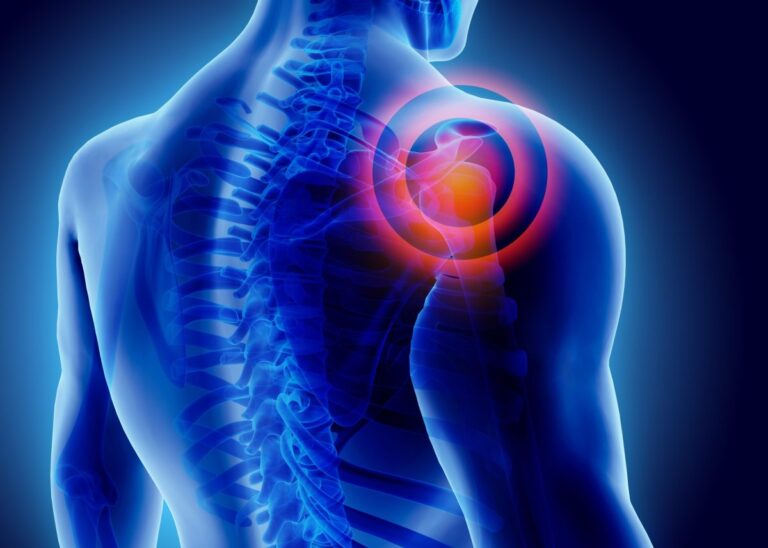
You used to press overhead without thinking twice and shoulder pain and rotator cuff injuries became part of your life. You used to throw combinations on the bag, knock out pull-ups, or toss a ball with your kid on the weekend without bracing yourself for what comes next. Now there’s that deep, nagging ache in your shoulder that shows up uninvited – during a bench press, reaching for something on a high shelf, or rolling onto the wrong side in your sleep.
If this sounds familiar, you’re not alone. Shoulder pain, particularly involving the rotator cuff is one of the most common issues we treat at Strike Physiotherapy & Performance in North Hollywood. And for active adults and athletes, the typical advice of “just stop what you’re doing and rest” isn’t just unhelpful – it completely misses the point.
According to the CDC’s National Health Interview Survey, over 30% of U.S. adults reported pain in their hands, arms, or shoulders in the past 3 months CDC – and that figure rises to nearly 38% among adults aged 45–64.
Here’s what’s actually going on with your shoulder, why it matters, and how the right physical therapy approach can get you back to training without surgery, injections, or months on the sideline.
Your Shoulder: Built for Mobility, Vulnerable by Design
Your shoulder joint trades stability for an extraordinary range of motion. It can reach overhead, rotate in multiple directions, and generate serious force, but that freedom comes with a cost. The structures responsible for keeping the joint centered and controlled have to work overtime, especially in people who train.
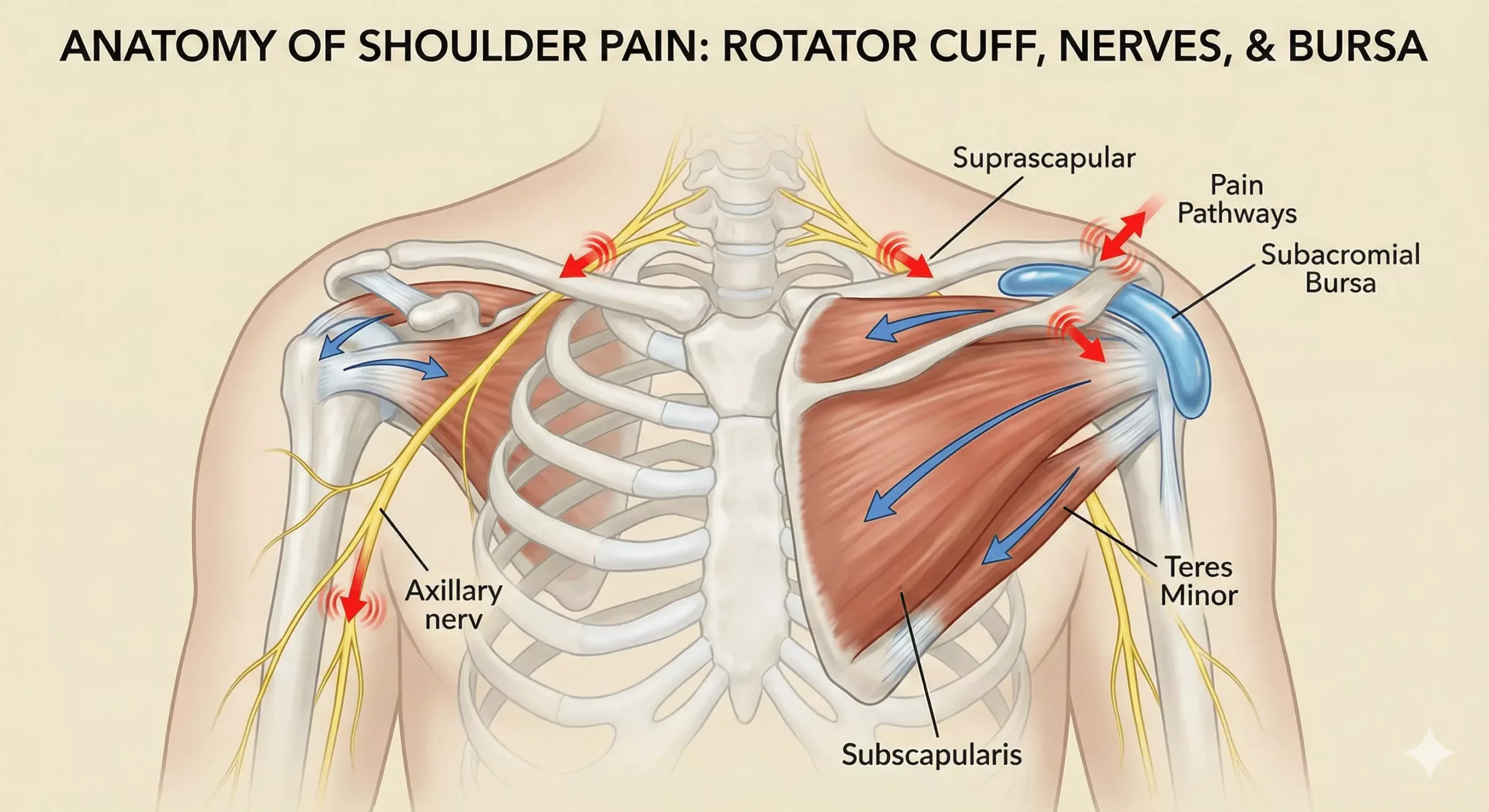
At the center of most shoulder complaints is the rotator cuff: a group of four muscles – supraspinatus, infraspinatus, teres minor, and subscapularis – and their tendons, which wrap around the shoulder joint like a dynamic sleeve. Together, they stabilize the ball in the socket during every push, pull, press, and rotation your arm performs.
When one or more of these muscles or tendons become irritated, partially torn, or overloaded, the result is pain that can range from a dull, persistent ache to sharp, activity-stopping discomfort. And because the shoulder is involved in almost everything your upper body does, that pain tends to bleed into every corner of your daily life.
We offer a free consult call with a licensed physical therapist to help you get answers to the issues and problems specific to your case.
What Causes shoulder pain and rotator cuff Injuries?
For the weekend warriors, gym-goers, and athletes we work with at Strike PT, rotator cuff injuries rarely come out of nowhere. Understanding what triggered yours is the first step toward fixing it – not just managing it.
Repetitive Training Demands. If your sport or workout routine involves a lot of overhead or rotational work – think pressing movements, swimming, combat sports, throwing, or even high-volume pull-ups – your rotator cuff is absorbing cumulative stress over time. It’s not always a single dramatic moment. Often it’s the gradual buildup of volume that your shoulder’s capacity hasn’t kept pace with.
Load That Outpaces Tissue Tolerance. This one hits home for lifters. You’re progressing your bench press, overhead press, or snatch, and your muscles are getting stronger – but the tendons and smaller stabilizers aren’t adapting at the same rate. One day, things feel “off.” You push through it, and then the shoulder starts talking louder. One Strike PT patient described it as “ego lifting” that caught up with them. There’s no shame in that – it’s one of the most common patterns we see.
Desk Work and Postural Habits. Hours spent hunched over a laptop or scrolling on your phone create a forward-shoulder, rounded-upper-back posture that narrows the space where your rotator cuff tendons operate. When you then go to the gym and press overhead or do lateral raises, you’re asking those tendons to work through a compromised position. The gym doesn’t cause the problem – but it exposes one that’s been building all day at your desk.
Age-Related Tendon Changes. After 40, tendon tissue naturally becomes less resilient. This doesn’t mean your shoulder is doomed – far from it. But it does mean that tendons need more intentional loading and recovery to stay healthy. The research is clear: well loaded tendons are strong tendons, regardless of age. The “you’re just getting older” narrative is rarely the full picture.
Acute Trauma. A fall onto an outstretched arm, a collision in a sport, or a sudden heavy lift can cause an acute rotator cuff tear. These are less common than the gradual-onset injuries described above, but when they happen, the right rehab approach is critical.
How Do You Know It’s Your Rotator Cuff?
Not every shoulder ache is a rotator cuff problem, and not every rotator cuff issue shows up the same way. But there are patterns that point in that direction:
A deep, dull ache inside or on the outside of the shoulder that’s hard to pinpoint with a single finger. Pain or weakness when lifting your arm out to the side or overhead – especially under load, like a dumbbell lateral raise or a pressing movement. Difficulty reaching behind your back, such as fastening a bra strap, tucking in a shirt, or reaching for your back pocket. Night pain that wakes you up or prevents you from sleeping on the affected side – this is the one that really wears people down. A grinding, clicking, or catching sensation during certain movements, particularly rotation.
If two or more of these sound familiar, your rotator cuff is likely involved. But here’s the critical part most people miss: the spot where it hurts isn’t always the spot that’s causing the problem. That’s why a thorough evaluation matters more than a Google search.
In order to help you plan your recovery instead of guessing which exercises will work best for you, we offer a physical evaluation that costs just $97 and has zero commitment.
This is not all. Before deciding if you want a physical evaluation with us or not, you can book a free discovery call, where one of our licensed therapists will assess if a physical evaluation is the best step for your shoulder pain and rotator cuff injury.
Why “Just Rest” Doesn’t Work for Shoulder Pain
If you’ve already been to a doctor and were told to stop lifting, stop training, take ibuprofen, and come back in six weeks – you’re not alone. That’s the story we hear from patients at Strike Physiotherapy almost every week.
Here’s the problem with that approach: rest removes the pain stimulus temporarily, but it does nothing to address why the shoulder was overloaded in the first place. While you’re resting, the muscles around the shoulder get weaker, the tendon doesn’t receive the progressive loading stimulus it needs to heal, and your overall fitness and mental health take a hit.
Research on rotator cuff tendinopathy consistently supports active rehabilitation – not passive rest – as the most effective conservative treatment. Your shoulder needs to be loaded, but it needs to be loaded correctly, at the right intensity, and progressed at the right pace.
That’s exactly what we do at Strike PT.
How We Treat Rotator Cuff Injuries at Strike PT
Our approach to shoulder rehab is built on three principles: find the root cause, stay active through recovery, and build back stronger than before. Here’s what that looks like in practice.
Phase 1: A Real Assessment – Not a Rushed Intake
Your first visit at Strike PT is a comprehensive, one-on-one biomechanical evaluation with Doctor of Physical Therapy, specifically designed for your shoulder pain or rotator cuff issues. This is not a 10-minute check-the-boxes intake where you get handed a sheet of band exercises and sent on your way.
We evaluate how your shoulder moves in the context of your whole body. How does your thoracic spine mobility affect your overhead position? What are your scapular muscles doing – or not doing – during a pressing movement? Is there a strength deficit in your rotator cuff, or is the real bottleneck somewhere else in the chain?
We also look at how you actually train. If you’re a lifter, we want to see your pressing mechanics. If you’re a combat athlete, we look at how you throw punches and elbows. The goal is to connect your pain to a specific movement dysfunction – and then explain it to you in plain language so you understand exactly what’s going on and what we’re going to do about it.
Patients consistently tell us this is the first time anyone has explained their shoulder pain in a way that actually makes sense.
Phase 2: Active Rehabilitation – Modify, Don’t Stop
Once we know what’s driving the problem, we build a treatment plan that keeps you in the gym, on the mat, or in your sport – with smart modifications that protect the shoulder while we fix it.
This phase combines hands-on manual therapy to improve joint mobility and reduce pain, targeted strengthening for the rotator cuff and scapular stabilizers using progressive loading principles, sport-specific movement corrections tailored to your activity (pressing mechanics for lifters, striking mechanics for combat athletes, overhead positioning for swimmers), and a structured home exercise program you can do at the gym or at home between sessions.
The key word is progressive. We don’t start you with the same generic theraband exercises for eight weeks. Your program evolves session by session based on how your shoulder responds – because a plan that doesn’t adapt isn’t really a plan.
Phase 3: Bulletproof Your Shoulder for the Long Haul
Getting you out of pain is the starting point – not the finish line. Once pain-free movement is restored, we shift into building resilience so this doesn’t happen again.
This is where Strike PT makes a real difference. We progress your shoulder through advanced loading patterns, teach you how to structure your training to protect your shoulder long-term, and give you the understanding to self-manage flare-ups confidently if they ever come back.
The result? Patients don’t just get back to where they were before the injury – they come back stronger, more informed, and more confident in how they train.
Real Results from Real Patients
We don’t expect you to take our word for it. Here’s what patients at Strike PT have experienced with shoulder injuries:
“I can’t remember the last time my shoulder hurt” – reported just 6 weeks after starting treatment.
“I literally enjoy myself at the gym now without pain” – from a lifter who was previously told to stop pressing entirely.
“He performed a thorough assessment and quickly pinpointed the root cause of my injuries” – the depth of the evaluation is the most common thing patients highlight.
“I feel empowered by the knowledge and confidence I’ve gained through this process” – because understanding your shoulder is just as important as treating it.
When Should You See a Physical Therapist for Shoulder Pain?
Don’t wait until you can’t lift your arm. If your shoulder pain has been present for more than a week or two, if it’s waking you up at night, if it’s forcing you to modify or skip workouts, or if you’ve been told to “just rest” and it hasn’t gotten better – that’s the signal.
Early intervention means faster recovery, less time away from your training, and a lower chance of the problem becoming chronic. And in most cases, you don’t need a doctor’s referral to start physical therapy in California – you can come directly to us.
Shoulder Pain Treatment in North Hollywood – Serving Burbank, Studio City and Surrounding Areas.
Strike Physiotherapy & Performance is located at 5017 Lankershim Boulevard in North Hollywood, just minutes from Burbank, Studio City, Sherman Oaks, Toluca Lake, and the greater Los Angeles area. We specialize in one-on-one, evidence-based care for active adults and athletes – not the high-volume, 10-minute-session model you may have experienced elsewhere.
If your shoulder is keeping you from the gym, the ring, the trail, or just a decent night’s sleep, we can help.