You’re mid-way through a set of overhead presses, reaching up to grab something off a shelf, or throwing a ball with your kid in the backyard. Then it hits – a sharp, catching pain right on the front or side of your shoulder, and you ask yourself. “Why Does My Shoulder Hurt?” and can’t find an answer.
If your shoulder hurts when lifting your arm overhead, you’re not alone. Overhead shoulder pain is one of the most common issues we see at Strike Physiotherapy & Performance in North Hollywood, especially in active adults between 30 and 55 who are trying to stay fit while juggling work, family, and the odd weekend sport.
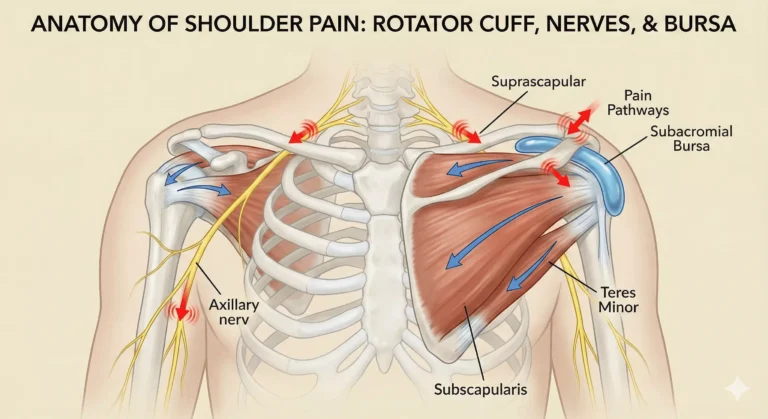
According to the National Library of Medicine, the symptoms causing shoulder pain can include swelling, damage, or bone changes around the rotator cuff.
The good news? In the vast majority of cases, this type of shoulder pain responds really well to the right approach. The frustrating part? Most people have been given the wrong approach for years.
Let’s break down what’s actually going on, clear up some outdated ideas, and talk about what the research says you should actually be doing about it.
What’s Actually Happening in Your Shoulder When You Reach Overhead?
For a long time, shoulder pain during overhead movements was blamed on “impingement” – the idea that bones in your shoulder were physically pinching your rotator cuff tendons every time you raised your arm. This led to a lot of people being told they had a “structural problem” that might need surgery to fix.
The reality is more nuanced. The current understanding, now referred to as subacromial pain syndrome (SAPS), recognises that your pain is likely a combination of several factors working together:
– Your rotator cuff tendons have become sensitised and deconditioned – meaning they react to loads they used to handle just fine. This is the hallmark of [rotator cuff tendinopathy](https://strikept.com/shoulder-pain-and-rotator-cuff-injuries/).
– The muscles that control your shoulder blade (particularly the lower and middle trapezius and the serratus anterior) have become weak or poorly coordinated.
– Your thoracic spine (mid-back) has stiffened up, forcing your shoulder to compensate every time you reach overhead.
– Training load, stress, sleep, and general health all influence how sensitive your shoulder is on any given day.
In other words, it’s rarely one single thing. And that’s actually good news – because it means there are multiple levers we can pull to help you feel better.
If two or more of these factors sound familiar, your rotator cuff is likely involved. But here’s the critical part most people miss: the spot where it hurts isn’t always the spot that’s causing the problem. That’s why a thorough evaluation matters more than a Google search.
To help you plan your recovery instead of guessing which exercises will work best, we offer a physical evaluation for just $97 with zero commitment. And before deciding if that’s right for you, you can book a free discovery call where one of our licensed therapists will assess whether a physical evaluation is the best next step for your shoulder pain.
Why Does My Shoulder Hurt When I Reach Overhead? Here’s What’s Actually Happening
The most common advice people get is to stop doing whatever hurts and wait for it to settle down. And sure, taking the foot off the gas for a few days can help calm an angry shoulder. But if rest is your only strategy, you’re going to be disappointed.
Here’s why: tendons adapt to the loads you put through them. When you rest a tendon for weeks or months, it actually loses capacity. It gets weaker, not stronger. So when you eventually try to go back to overhead pressing or playing tennis, your tendon has even less ability to handle the load than before.
The pain comes back – often worse – and you’re stuck in a frustrating cycle of flare-up → rest → return → flare-up.
Think of it like this: if you put your arm in a sling for six weeks, the muscles would waste away. Your tendons work the same way. They need load to stay healthy. The trick is finding the right type and amount of load – and that’s where most people get stuck without professional guidance.
What the Research Actually Recommends for Overhead Shoulder Pain
The current evidence is clear: Progressive loading is the most effective treatment for rotator cuff tendinopathy and subacromial pain syndrome. This means gradually increasing the demand on your shoulder in a structured way – starting from a level that your tissues can tolerate right now and building from there.
Here’s the loading progression that most evidence-based clinicians use:
Stage 1 – Isometric Loading (Pain Reduction Phase)
These are static holds where the muscle works hard but the joint doesn’t move. Research has shown that isometric exercises can **reduce tendon pain significantly** and help “wake up” muscles that shoulder pain has switched off. This is where most people should start.
Stage 2 – Slow, Through-Range Strengthening
Once isometrics are comfortable, you progress to exercises that take the shoulder through its full range with control: band rotations, dumbbell work, and scapular exercises like prone Y-raises and push-up variations.
Stage 3 – Heavier Loading With Eccentric Emphasis
Eccentric exercises (controlled lowering under load) have been shown to produce greater strength gains and promote tendon remodeling. This is the stage where your shoulder starts building real, lasting capacity.
Stage 4 – Speed, Power, and Return to Sport
If your goal involves throwing, overhead sport, or gym-based pressing like the overhead press, the final stage reintroduces fast, dynamic, and reactive movements: medicine ball throws, plyometric push-ups, and sport-specific drills.
This isn’t a “one-size-fits-all” timeline. Some people fly through the early stages in a couple of weeks. Others need longer. The key principle is that you progress based on your pain response and movement quality, not based on an arbitrary calendar.
That said, knowing which stage you’re in – and when to move forward – is difficult to judge on your own. A structured loading program designed for your specific shoulder is significantly more effective than a generic YouTube routine.
If you’ve been stuck in the flare-up cycle, book a free discovery call with a Doctor of Physical Therapy to find out exactly where you should be starting.
Three Exercises You Can Start Doing Today for Shoulder Pain
These are safe entry points that most people with overhead shoulder pain can begin at home. All three can be done in under 10 minutes and should stay below 3 out of 10 on the pain scale.
1. Isometric External Rotation
Stand with your elbow bent 90°, hand facing forward, and push the back of your hand into a wall or door frame. Hold for **30-45 seconds** at about 50–70% effort. Do **5 sets**. This is one of the most well-supported entry points for shoulder tendon pain.
2. Scapular Setting
Sit or stand tall. Gently squeeze your shoulder blades together and down – like you’re putting them in your back pockets – and hold for **5 seconds**. Repeat **10 times, 3 sets**. This starts retraining the muscles that control your shoulder blade, which is critical for long-term recovery from subacromial pain syndrome.
3. Thoracic Extension Over a Foam Roller
Lie on your back with a foam roller under your mid-back. Gently extend backward over the roller **10 times**. If your mid-back is stiff, your shoulder has to work harder to get overhead. Improving thoracic mobility here takes pressure off the shoulder joint.
When Should You See a Physical Therapist for Shoulder Pain?
If your shoulder pain has been hanging around for more than a couple of weeks, is stopping you from training or sleeping, or keeps coming back every time you try to push through it – it’s worth getting a proper assessment.
A good physical therapist will identify which specific factors are driving your pain and build a structured loading program tailored to your shoulder, your goals, and your lifestyle.
The earlier you start the right loading approach, the faster you’ll get back to doing what you love. Waiting and hoping it sorts itself out usually just means you lose more time – and more capacity in that tendon.
If you’re in North Hollywood, Burbank, Studio City, or the surrounding Los Angeles area, we at Strike Physiotherapy specialize in getting active adults back to training without surgery or injections. We start every new patient relationship with a [free discovery call](https://strikept.com/contact-us/) so you can talk to a licensed Doctor of Physical Therapy before committing to anything.
Or call us directly at (818) 351-1623.
Frequently Asked Questions About Overhead Shoulder Pain
Why does my shoulder hurt only when I reach overhead?
Overhead movements place the highest demand on your rotator cuff tendons and shoulder blade muscles. If these structures have become deconditioned or sensitized – often from a sudden increase in training, prolonged desk posture, or age-related changes – they may only produce pain at the end range where load is greatest.
Is shoulder pain when lifting overhead a sign of a rotator cuff tear?
Not necessarily. Most overhead shoulder pain in active adults is caused by rotator cuff tendinopathy or subacromial pain syndrome, not a structural tear. Research shows that many people with rotator cuff tears on imaging have zero pain, and many people with significant pain have completely intact tendons. A thorough physical assessment is more useful than an MRI for determining what’s actually driving your symptoms.
Should I stop overhead pressing if my shoulder hurts?
Not always. Complete avoidance often makes the problem worse long-term because your tendons lose capacity without load. The better approach is to temporarily modify the movement – reduce the weight, change the angle, or switch to an isometric variation – and then gradually rebuild. A physical therapist can help you find the right modification so you don’t have to stop training entirely.
How long does it take to fix shoulder pain from reaching overhead?
Most people with rotator cuff tendinopathy see meaningful improvement within 6-12 weeks of a structured, progressive loading program. However, timelines vary depending on how long the pain has been present, your overall health, and how consistently you follow the program. Early intervention generally leads to faster recovery.
Can I fix overhead shoulder pain without surgery?
Yes. The vast majority of subacromial pain syndrome and rotator cuff tendinopathy cases respond well to physical therapy and progressive loading – without surgery, injections, or medication. Surgery is rarely needed and is typically only considered after a full course of conservative treatment has been tried.