
If you’ve been living with chronic pain, chances are you’ve been handed a prescription and sent on your way. And while that might offer short-term relief, many patients find themselves asking: why am I still hurting months – or years – later?
At Strike Physiotherapy & Performance in North Hollywood, we work with chronic pain patients every day. One of the most common conversations we have is about the difference between managing pain with medication versus actually treating the underlying cause through physical therapy.
This guide breaks down both approaches honestly — because you deserve a real answer, not just another pill.
Physical Therapy vs. Pain Medication: Long-Term Solution
Let’s be clear: pain medication has its time and place. Following surgery, a serious injury, or during an acute flare-up, medication can be an important part of short-term care. At Strike Physiotherapy & Performance, we work alongside your medical team – we’re not here to dismiss any part of your care plan.
But here’s the reality: pain medication has been heavily overprescribed across North America, and the evidence for long-term benefit – particularly for chronic pain – is far weaker than most patients are led to believe.
The Risks of Long-Term Pain Medication Use
Opioids:
– High risk of physical dependence and tolerance (requiring increasing doses for the same effect)
– Linked to cognitive impairment, hormonal disruption, and increased pain sensitivity over time (opioid-induced hyperalgesia)
– The ongoing U.S. opioid crisis tracked by the CDC is a direct consequence of using these medications as a first-line, long-term pain solution
NSAIDs (ibuprofen, naproxen, etc.):
– Chronic use is associated with gastrointestinal bleeding, kidney damage, and elevated cardiovascular risk
– Provide symptom relief only – the pain returns when the medication stops
The core issue is that medication masks the pain signal. It does not fix what’s causing it. For chronic pain especially, this means patients can spend months or years on prescriptions that are treating the alarm, not the fire.
Why Physical Therapy Outperforms Medication for Chronic Pain
At Strike Physiotherapy & Performance, our approach to chronic pain goes beyond exercises and stretches. We treat the whole picture — the physical dysfunction, the movement patterns, and even the way the nervous system has learned to process pain.
1. We Address the Root Cause
Where medication asks *”how do we quiet this signal?”*, physical therapy asks *”why is this signal firing, and what do we do about it?”*
Whether the source of your pain is a herniated disc, osteoarthritis, a sports injury, or a postural imbalance that has built up over years — your Strike Physiotherapy & Performance team will identify it, assess it, and build a targeted plan around it.
2. Physical Therapy Produces Results That Last
The strength you build, the mobility you regain, and the movement patterns you correct through physiotherapy don’t disappear when your sessions end. Unlike medication, the benefits are cumulative and carry forward into your everyday life.
3. Pain Science and the Nervous System
Chronic pain is not always a sign of ongoing tissue damage. In many cases, the nervous system becomes sensitised — continuing to fire pain signals long after the original injury has healed. This is called central sensitisation, and it’s a key factor in conditions like:
– Chronic low back pain
– Fibromyalgia
– Persistent neck pain
– Post-surgical pain syndromes
At Strike Physiotherapy & Performance, our clinicians are trained in pain neuroscience education — helping you understand what’s driving your pain and how to interrupt those patterns. This evidence-based approach is something no prescription can replicate.
4. Reduced Dependence on Medication
Many of our clients come to us having been on pain medication for months or years. A consistent finding in both research and our own clinical experience: as physiotherapy progresses and function improves, the need for medication decreases.
If you’re currently on long-term pain medication and wondering whether physical therapy could help you reduce your reliance on it, book a free discovery call with one of our licensed Doctors of Physical Therapy. We’ll give you an honest assessment of what’s possible for your specific situation.
What the Research Says About Physical Therapy vs. Pain Medication
The science strongly supports physiotherapy as a first-line approach to chronic pain management:
– The American College of Physicians recommends non-pharmacological treatments – including physical therapy – as the first-line treatment for acute, subacute, and chronic low back pain.
– Research published through JAMA Network has shown that non-drug therapies, including physical therapy, are effective for chronic low back pain and often outperform medication for long-term outcomes.
– For knee osteoarthritis, supervised exercise therapy shows results comparable to NSAIDs – without the gastrointestinal or cardiovascular risks.
– A systematic review hosted on The BMJ found that physiotherapy-based interventions significantly reduced opioid use in patients with musculoskeletal pain.
– The American Physical Therapy Association (APTA) and their consumer resource ChoosePT both highlight physical therapy as a safer, evidence-based alternative to long-term pain medication.
The clinical consensus is clear: for most chronic musculoskeletal pain, physical therapy should be tried before – or alongside – pharmacological treatment, not after it has failed for years.
Who Benefits Most From Physiotherapy Over Medication?
Physical therapy tends to be especially impactful for patients dealing with:
– Chronic low back pain – one of the most overprescribed conditions for opioids
– Neck pain and cervicogenic headaches
– Osteoarthritis of the knee, hip, or shoulder
– Post-surgical recovery (where PT accelerates return to function)
– Fibromyalgia*and central sensitisation disorders
– Sports injuries – both acute and recurring
– Sciatica and disc-related pain
If any of these sound familiar, a physical therapy assessment at Strike Physiotherapy & Performance could be a turning point in your care. Book your free discovery call here.
Medication or Physiotherapy? Here’s How to Think About It
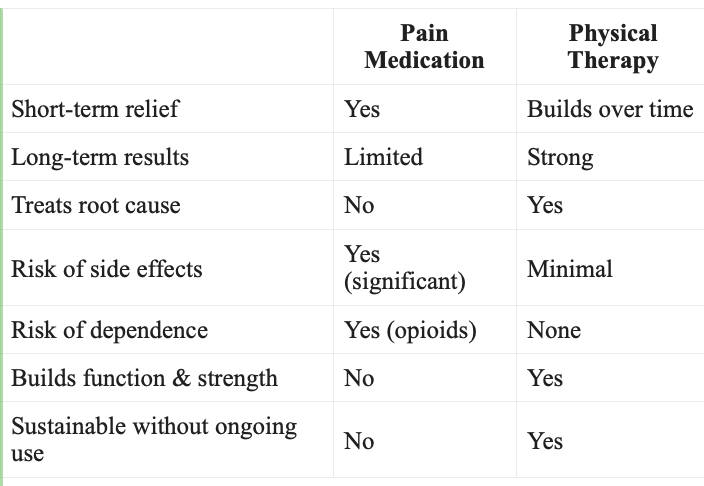
The smart path for most chronic pain patients isn’t medication or physiotherapy — it’s using medication appropriately in the short term while physical therapy does the real work of solving the underlying problem.
The Strike Physiotherapy & Performance Approach to Chronic Pain
At Strike Physiotherapy & Performance, we believe you deserve more than symptom management. Our team takes the time to understand your history, your goals, and the specific mechanisms driving your pain — and then we build a plan designed to move you toward lasting relief.
We don’t believe in a one-size-fits-all approach. Whether you need hands-on manual therapy, a targeted exercise program, dry needling, or pain science coaching, your treatment will be built around you.
And if medication is part of your current care, we’re happy to work alongside your physician to create a plan that supports gradual reduction as your function improves — always at a pace that’s safe and appropriate for your situation.
When to Book a Physical Therapy Assessment
If you’ve been relying on pain medication for more than a few weeks, if your current prescription isn’t working as well as it used to, or if you simply want to understand whether physical therapy could be a better long-term option — a proper assessment is the fastest way to get clarity.
At Strike Physiotherapy & Performance, we serve North Hollywood, Burbank, Studio City, and the surrounding Los Angeles area. Every new patient starts with a free discovery call so you can talk to a licensed Doctor of Physical Therapy before committing to anything.
Or call us directly at (818) 351-1623.
Frequently Asked Questions About Physical Therapy vs. Pain Medication
Can I do physical therapy while taking pain medication?
Yes. In many cases, physical therapy and medication work together in the short term. The goal is to build your function to the point where reliance on medication decreases over time. We always coordinate with your physician when medication is part of your care.
Is physical therapy really better than pain medication for chronic back pain?
For most cases of chronic low back pain, yes. The American College of Physicians and multiple systematic reviews recommend non-drug approaches like physical therapy as **first-line treatment** — before long-term medication. Medication can help manage flare-ups, but it doesn’t address the underlying dysfunction driving the pain.
How long does it take to see results from physical therapy?
Most patients notice meaningful improvement within 4–8 weeks of consistent treatment. Chronic conditions may require a longer commitment — but the results are durable and continue to pay off long after formal sessions end.
Can physical therapy help me reduce or stop opioid use?
Often, yes. Research consistently shows that structured physical therapy reduces opioid use in patients with musculoskeletal pain. Any reduction in prescription medication should always be done under the guidance of the prescribing physician — but physical therapy gives your body the capacity to function without it.
Does physical therapy work for fibromyalgia and central sensitisation?
Yes. Physical therapy that incorporates pain neuroscience education, graded exercise, and nervous system desensitisation strategies is one of the most effective non-drug approaches for fibromyalgia and chronic widespread pain.
Is physical therapy covered by insurance?
Most US health insurance plans cover physical therapy to some degree. Coverage varies significantly by plan, so we recommend checking your specific benefits. Our front desk team can help you verify coverage before your first appointment.
How do I get started at Strike Physiotherapy & Performance?
The easiest way is to book a [free discovery call](https://strikept.com/contact-us/) through our website or call us at (818) 351-7623. Your first appointment includes a full assessment, a clear diagnosis, and a personalised treatment plan.