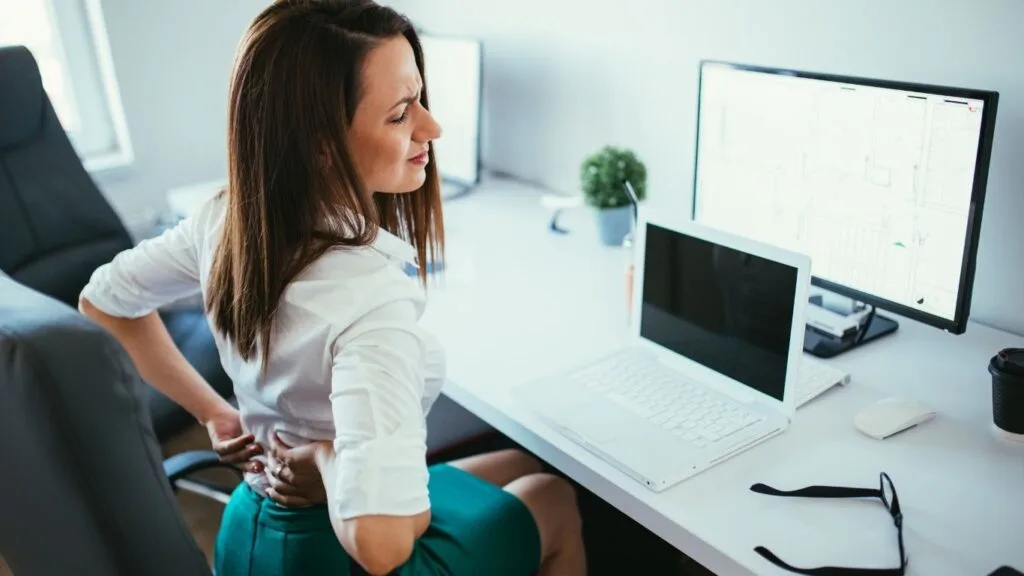
If you have lower back pain from sitting all day, you are far from alone. Lower back pain from sitting is the leading cause of disability worldwide, affecting an estimated 577 million people at any given time.
And for the millions of people who sit at a desk for 8+ hours a day, prolonged sitting is one of the most modifiable contributors to that pain. The good news: there is a substantial and growing body of research on exactly what causes it and more importantly what actually fixes it.
If you’ve been dealing with lower back pain that won’t go away no matter how many stretches you try, schedule a discovery call with one of our Doctors of Physical Therapy. We’ll help you figure out exactly what’s going on no obligation, no pressure.
This blog breaks it all down.
Why Does Sitting Cause Lower Back Pain?
Sitting is not inherently dangerous, but prolonged, uninterrupted sitting places the lumbar spine in a sustained flexed position that loads the posterior spinal structures intervertebral discs, facet joints, and surrounding ligaments for hours at a time. Several mechanisms contribute to lower back pain from sitting:
Disc Loading
Intradiscal pressure increases significantly in sitting compared to standing. Sustained pressure impairs the nutrient exchange that spinal discs depend on, as they are avascular structures that rely on diffusion.
Posterior Chain Deactivation
When you sit, your glutes, deep lumbar stabilizers (multifidus), and hip flexors shift toward shortened or inhibited states. This altered muscle recruitment persists even after you stand up.
Lumbar Flexion Creep
Sustained loading in a flexed posture causes viscoelastic “creep” in spinal ligaments and discs a gradual deformation that reduces spinal stiffness and increases injury vulnerability, particularly at the end of the workday.
Reduced Spinal Blood Flow
Prolonged static posture reduces local tissue perfusion and can contribute to ischemic pain, particularly in the paraspinal musculature.
Importantly, sedentary time itself is independently associated with broader health risks. A systematic review and meta analysis analyzing 47 studies across nearly 800,000 participants found that prolonged sedentary time was associated with significantly increased risk of cardiovascular disease, type 2 diabetes, cancer, and all cause mortality, even in individuals who met physical activity guidelines. This means the risks of sitting go well beyond lower back pain.
Does Sitting Actually Cause Lower Back Pain? What the Evidence Shows
The relationship between occupational sitting and lower back pain is real, but more nuanced than many assume.
A systematic review examining 43 studies found associations between occupational sitting and musculoskeletal symptoms, though the evidence was mixed across study designs. A separate systematic review concluded that while sitting is associated with back pain complaints, causal evidence is limited suggesting that sitting is a contributing factor, not an isolated cause.
What does emerge consistently from the literature is this: physical inactivity is a stronger and more consistent predictor of lower back pain than sitting alone. A meta analysis of 36 prospective cohort studies found that leisure time physical activity was protective against low back pain reinforcing that movement is medicine.
The takeaway: It is not just that you sit it is that you sit without moving enough. Both factors matter, and both are addressable.
Not sure whether your lower back pain is from sitting, weak muscles, or something else entirely? A quick conversation with a physical therapist can save you months of guessing. Book a discovery call and get a clear answer.
How Much Sitting Is Too Much for Your Lower Back?
The 2020 WHO Guidelines on Physical Activity and Sedentary Behaviour state clearly: “All adults should limit the amount of time spent being sedentary. Replacing sedentary time with physical activity of any intensity, including light intensity, provides health benefits.”
There is no universally agreed “safe” threshold for daily sitting time, but research consistently associates sitting beyond 8,10 hours per day with elevated musculoskeletal and metabolic risk. For a typical desk worker, structured breaks, postural variation, and targeted exercise are the primary tools for reducing lower back pain from sitting.
What Actually Works: Evidence Based Treatments for Lower Back Pain from Sitting
Here is where the research is most actionable. The American College of Physicians (ACP) published a major clinical practice guideline based on a systematic review of 150+ trials on noninvasive treatments for low back pain. Their conclusions are clear and often surprising to patients:
First Line Treatments for Acute and Subacute Lower Back Pain (Less Than 12 Weeks)
– Superficial heat
– Massage
– Acupuncture
– Spinal manipulation
First Line Treatments for Chronic Lower Back Pain (12+ Weeks)
– Exercise therapy
– Multidisciplinary rehabilitation
– Mindfulness based stress reduction
– Cognitive behavioral therapy
– Spinal manipulation, massage, acupuncture, low level laser therapy
The ACP recommends against opioid medications as first line treatment for lower back pain in most patients.
For desk workers with pain driven by prolonged sitting, exercise therapy is the cornerstone of treatment and it is the intervention with the most robust evidence base.
Exercise Therapy: The Most Evidence Backed Solution for Lower Back Pain from Sitting
A 2021 Cochrane systematic review the most comprehensive synthesis of its kind, analyzing 249 randomized controlled trials found that exercise therapy produces significantly greater improvements in pain and functional ability compared to no treatment or usual care for chronic low back pain. Importantly, no single exercise type was definitively superior meaning consistency and specificity to your presentation matter more than choosing the “right” modality.
For lower back pain from sitting specifically, the following exercise categories have the strongest evidence and direct mechanism relevance:
1. Lumbar Stabilization Exercises
Stabilization training targets the deep segmental muscles of the spine primarily the lumbar multifidus and transverse abdominis that are selectively inhibited in people with lower back pain. These muscles provide dynamic spinal stiffness and are particularly important for protecting the lumbar spine during transitions from sitting to standing and during functional movement.
Research consistently shows that stabilization exercises produce significantly greater reductions in pain and disability than control conditions, with benefits sustained at long term follow up. Multiple meta analyses confirm that stabilization exercises outperform general exercise and manual therapy for pain reduction in chronic lower back pain.
Core stabilization exercises commonly used in physical therapy for lower back pain from sitting:
– Dead bug: Supine, alternating arm/leg extension while maintaining a neutral spine. Targets the deep stabilizers without loading the lumbar spine in flexion.
– Bird dog: Quadruped contralateral arm/leg extension. Directly activates the lumbar multifidus and challenges postural endurance.
– Side plank: Lateral core endurance. Targets the quadratus lumborum and lateral stabilizers, which are commonly weak in desk workers with hip drop or lateral trunk shift patterns.
2. Hip and Glute Strengthening
Prolonged sitting causes adaptive shortening of the hip flexors and inhibition of the gluteal muscles a pattern often described clinically as “gluteal amnesia.” When the glutes fail to generate adequate force during standing, walking, and lifting, the lumbar erectors compensate, creating excessive compressive load on the posterior spinal structures.
Targeting the glutes with hip hinges, bridges, and Romanian deadlifts is a direct treatment for this compensation pattern and is routinely incorporated into physical therapy protocols for lower back pain from sitting.
3. Hip Flexor Mobility
The iliopsoas and rectus femoris become adaptively shortened with prolonged hip flexion. Tightness in these structures creates an anterior pelvic tilt and increased lumbar lordosis, which can compress the posterior facet joints and contribute to extension pattern pain. Sustained hip flexor stretching (kneeling hip flexor stretch, Thomas stretch) combined with active mobility work addresses this component.
4. Aerobic Exercise
Walking, cycling, and swimming all reduce lower back pain through multiple mechanisms: improved spinal disc nutrition via hydrostatic loading and diffusion, endorphin release, reduced inflammatory mediators, and improved central pain sensitization. Even moderate intensity walking (30 minutes, 3 5 days/week) has a meaningful effect on chronic lower back pain symptoms and should be considered a foundational component of any treatment program.
The right exercise program depends on your specific pain pattern and movement limitations. If you’ve been trying exercises on your own without lasting results, a physical therapist can identify exactly what your body needs. Book a discovery call to get a personalized assessment.
Workplace Strategies That Actually Help Lower Back Pain from Sitting
Sit stand desks are among the most commonly recommended workplace interventions for lower back pain but what does the research actually show?
Research shows sit stand workstations produce a statistically significant reduction in low back discomfort, though the effect size is modest. A randomized controlled trial found significant reductions in both current and worst back pain in desk workers with chronic lower back pain who used sit stand workstations.
The key caveat: standing all day is not the answer. Research shows that prolonged occupational standing is independently associated with musculoskeletal symptoms. The evidence supports postural variation alternating between sitting and standing not replacing one static posture with another.
Evidence based sit stand protocol: Aim to change position every 30 45 minutes. A commonly cited target is approximately 50% sitting and 50% standing across the workday, though individual tolerance varies.
Microbreak Protocols
Brief, structured movement breaks even 2 minutes of walking or standing every 30 minutes interrupt the postural creep and muscular deactivation that drive lower back pain from sitting. The WHO guidelines and multiple occupational health studies support integrating movement into the workday as a primary prevention strategy. Setting a timer or using a wearable prompt is one of the simplest and highest yield interventions available.
Ergonomic Desk Setup: The Basics
While ergonomic optimization alone is insufficient to treat existing lower back pain, it reduces the biomechanical load during sitting and should accompany any exercise intervention. Key parameters:
Chair height: Feet flat on floor; hips and knees at ~90°
Lumbar support: Chair back supports natural lumbar curve; avoid prolonged slouching |
Monitor height: Top of screen at or slightly below eye level; arm’s length away |
Keyboard position: Elbows at ~90°; shoulders relaxed, not elevated |
Hip position: Hips slightly above knee level (seat wedge or slight forward tilt can help)
A Practical Daily Protocol for Lower Back Pain from Sitting
Based on the clinical practice guidelines and exercise research reviewed above, here is a practical framework your physical therapist can individualize for your specific presentation:
Morning (before work): Hip flexor stretch, cat cow mobility, bird dog, dead bug | 10,15 min
Every 30,45 min at desk: Stand, walk briefly, do a standing hip hinge or lumbar extension stretch | 2,3 min
Lunch break: 10,20 min walk | 10,20 min
After work (3,5x/week): Structured exercise: stabilization program + aerobic activity | 30,45 min |
Evening: Glute bridge, side plank, hip flexor stretch | 5,10 min
Note: This is a general framework. The specific exercises, sets, reps, and progression depend on your diagnosis, pain behavior, and physical examination findings. A physical therapist will tailor this to your individual presentation.
Want a program built specifically for your lower back pain not a generic routine from the internet? Our physical therapists specialize in helping desk workers get out of pain and stay out of pain. Schedule your discovery call today.
Red Flags: When Lower Back Pain Needs Immediate Medical Attention
Most lower back pain from sitting is non specific and benign, but certain symptoms require prompt medical evaluation. Seek care immediately if you experience:
– Bowel or bladder dysfunction (especially new onset incontinence or retention)
– Saddle anesthesia (numbness in the groin or inner thighs)
– Significant leg weakness that is worsening
– Back pain accompanied by unexplained fever, weight loss, or night sweats
– Back pain following a fall, motor vehicle accident, or trauma
– Pain that is severe, constant, and does not change with position
These may indicate serious pathology including cauda equina syndrome that requires urgent workup.
How to Fix Lower Back Pain from Sitting: What You Should Do Starting Today
1. Break up your sitting. Set a timer. Move for 2,3 minutes every 30,45 minutes. This is the single lowest barrier, highest impact change you can make.
2. Start a structured exercise program. Exercise therapy has the strongest evidence base of any intervention for chronic lower back pain. You do not need to train hard you need to train consistently.
3. Strengthen your glutes and deep stabilizers. These muscles protect your lumbar spine and are directly inhibited by prolonged sitting.
4. Stretch your hip flexors daily. Shortened hip flexors are one of the most consistent postural findings in desk workers with lower back pain.
5. Consider a sit stand workstation if you sit more than 6 hours per day the evidence supports modest but real reductions in back discomfort.
6. See a physical therapist. The ACP guidelines place exercise therapy and manual physical therapy as first line interventions for chronic lower back pain ahead of medications. A PT will identify your specific impairments and build a targeted program.
7. Do not fear movement. Evidence consistently shows that avoiding activity worsens long term outcomes. Movement, done correctly, is therapeutic.
Book Your Discovery Call Today
You don’t have to keep living with lower back pain from sitting all day. Talk to a Doctor of Physical Therapy directly no pressure, no obligation. We’ll assess your situation, identify what’s driving your pain, and map out a clear plan to fix it.
Or call us directly at (818) 351 1623.
Frequently Asked Questions About Lower Back Pain from Sitting
How long does it take to fix lower back pain from sitting all day?
Most desk workers with lower back pain from sitting see meaningful improvement within 4,8 weeks of consistent exercise therapy and movement habit changes. However, the timeline depends on how long you’ve had pain, your overall fitness level, and whether there are underlying structural issues. A physical therapist can give you a realistic timeline based on your specific situation.
Is it better to sit or stand at a desk for lower back pain?
Neither sitting nor standing all day is ideal. The research supports alternating between sitting and standing every 30,45 minutes. Prolonged standing can cause its own set of musculoskeletal problems. Postural variation — not a single “perfect” posture — is what protects your back.
Can sitting too much cause permanent back damage?
For the vast majority of people, lower back pain from sitting is functional and reversible — it’s caused by muscle deactivation, postural stress, and deconditioning, not permanent structural damage. With the right exercise program and movement habits, most people can fully resolve their symptoms. If yours is not improving, see our back pain treatment in North Hollywood.
What is the best chair for lower back pain?
No single chair eliminates back pain. The most important factors are proper lumbar support, seat height that allows your feet to rest flat on the floor with hips and knees at approximately 90 degrees, and — most critically — not sitting in any chair for more than 45 minutes without a movement break. The best chair is the one you get out of regularly.
Should I use a lumbar roll or back support cushion?
A lumbar roll can help maintain your natural spinal curve while sitting and reduce posterior disc loading. It’s a reasonable low cost addition to your setup — but it’s a supplement to movement and exercise, not a replacement. If you need a lumbar roll to get through the day pain free, that’s a sign your back needs targeted strengthening.
When should I see a physical therapist for lower back pain from sitting?
If your lower back pain has persisted for more than a few weeks despite movement breaks and stretching, if it’s affecting your ability to work or exercise, or if you’re experiencing any radiating pain into your legs, it’s time to see a physical therapist. The earlier you address it, the faster and easier it is to resolve. Book a discovery call to get started.